Instant Vertical Lockdown: The Fastest Way to Contain a Lobby Threat
When a threat enters your building, every second matters. In active shooter scenarios or armed intrusions, your best line of defense is containment-and that starts in the lobby.
Instant vertical lockdown is the most reliable method to trap the threat where law enforcement can quickly intervene-before they reach upper floors where chaos spreads and evacuations become dangerous.
Here’s how it works-and why every building should be ready to activate it in a single action.
What Is Instant Vertical Lockdown?
It’s the ability to disable elevator access above the lobby with one command-automated by sensors or triggered manually by staff. The goal: confine the attacker to the ground floor and prevent upward movement entirely.
Done right, it protects tenants, reduces risk to first responders, and gives law enforcement a focused zone for engagement.
Key Principles for Containment
- Stop vertical movement. Prevent the attacker from reaching tenant floors or stairwells.
- Clear the lobby. Evacuate employees and visitors if safe to do so.
- Automate where possible. Rely on gunshot detection, aggression analytics, or panic button triggers to instantly disable elevators. Manual overrides are essential-but automation ensures no time is lost.
For Traditional Elevator Systems
- Most buildings still use “two-button” elevator systems. There are multiple ways to lock these down:
- Floor-Button Lockout: A command disables all car-call buttons above the lobby.
- Card-Reader Lockout: Credentials are blocked from calling an elevator at the lobby.
- One-Touch Lockdown: Security platforms like BluSKY allow a single soft-button to activate lockdown across multiple systems-available at the front desk, SOC, or via a secure mobile app.
👉 Pro tip: Always keep the lobby as a “free” floor so people can exit safely or return from upper floors.
For Destination-Dispatch Elevators
Destination-based elevators require more complex coordination:
- Card-Reader Lockout (Preferred): Disables all dispatch readers to block elevator calls.
- Schedule Swap: Push an emergency profile to every keypad. Effective but slower.
- Vendor API Commands: Some elevator manufacturers offer a “lock all” API call. Others may require direct coordination with a service technician.
Each system is different-test and validate integrations during commissioning.
Triggering Lockdown: Automation + Backup
Build redundancy into your lockdown response with multiple control options:
| Control Type | Where It Lives | Why It Matters |
| Automatic Sensors | Gunshot detectors, analytics | Fastest way to trigger lockdown |
| Fixed Consoles | Lobby desk, security office, SOC | Reliable manual backup |
| Mobile App Interface | Secure smartphone or tablet | Gives security control if consoles fail |
Don’t forget: always include a clearly marked “Reset” button to restore elevator function after the all-clear.
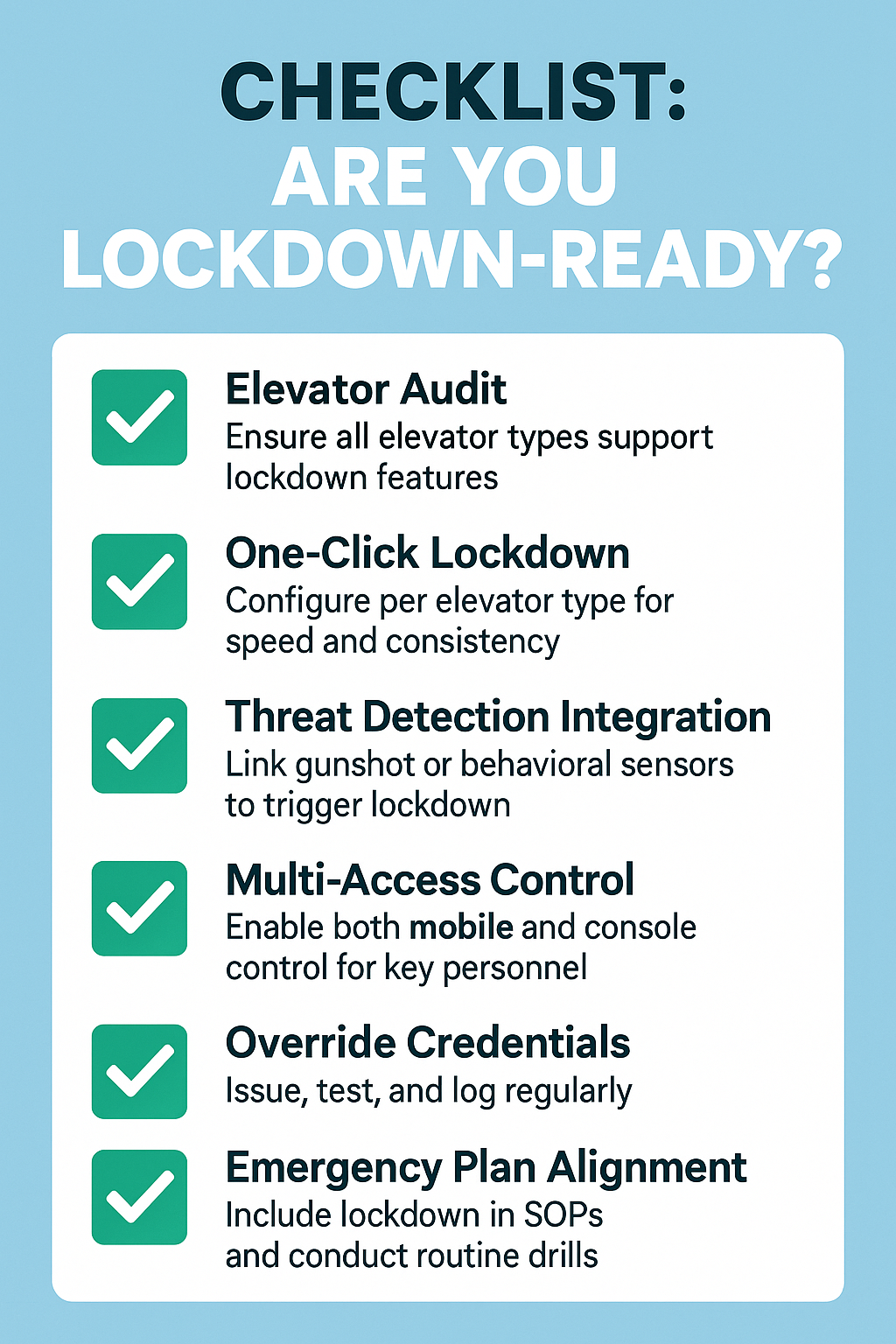
Checklist: Are You Lockdown-Ready?
The Takeaway
- Elevator lockdown isn’t just a smart strategy-it’s a life-saving one. When the unthinkable happens, a fast, automated response can mean the difference between containment and catastrophe.
- With BluSKY, instant vertical lockdown becomes a seamless part of your building’s emergency response-giving you control when it matters most.